What Happened
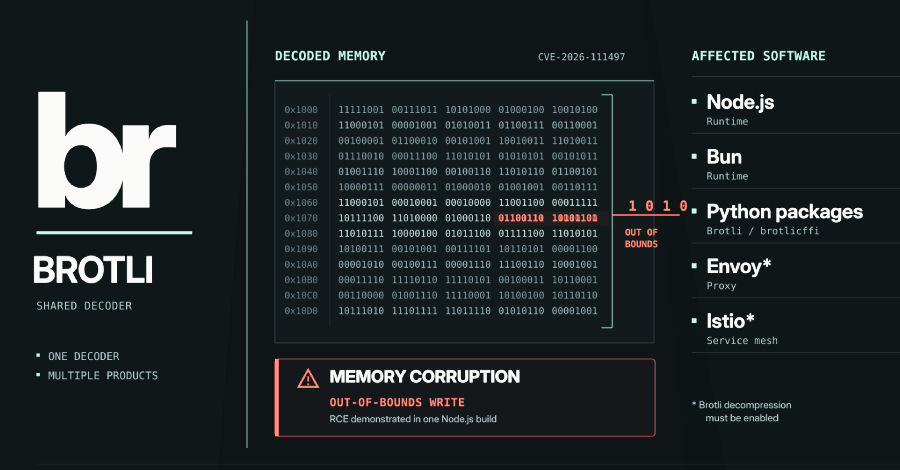
A critical memory-corruption vulnerability discovered in Google's Brotli decoder impacts a broad range of popular runtime environments, programming libraries, and proxy servers. tracked as CVE-2026-111497, the security flaw—which previously prompted Remote Code Execution (RCE) concerns in Node.js—also exposes systems running Bun, Python compression packages, and Envoy proxies to potential memory corruption.
The Key Details
- CVE ID: CVE-2026-111497
- Flaw Type: Memory corruption via buffer overflow during decompression.
- Affected Systems: The Bun JavaScript runtime, Python's `Brotli` and `brotlicffi` packages, and Envoy proxy servers configured to decompress Brotli traffic.
- Exploitation Mechanism: Attackers can send crafted Brotli-compressed data designed to bypass standard safety checks, overwriting memory past the designated buffer end.
Why It Matters
Brotli is a standard compression algorithm used heavily across the web to reduce file sizes and improve page load speeds. Because key infrastructure components—including application runtimes and reverse proxies—routinely decompress untrusted incoming data, a memory corruption flaw in the underlying decoder opens dangerous attack vectors. Successful exploitation could lead to application instability, service crashes, or potential remote code execution on target servers.
What It Means for Readers
- For Developers & Engineers: Development teams utilizing Bun, Python Brotli bindings, or Envoy proxies must review their tech stacks and apply upstream security updates that patch the decoder flaw.
- For System Administrators & DevOps: Infrastructure handling user-submitted compressed traffic should be audited immediately to ensure reverse proxies or decompression microservices are protected.
What Happens Next
Software maintainers across the impacted projects are issuing security updates incorporating fixed versions of the Brotli decoder. System operators should monitor official releases for Node.js, Bun, Envoy, and Python package registries to deploy patches as soon as they become available.
VANTIX Takeaway
When a fundamental library like Google's Brotli decoder suffers a buffer boundary flaw, the risk quickly propagates across the entire modern software stack, reinforcing the critical need for fast patch management across server runtimes and proxies.


