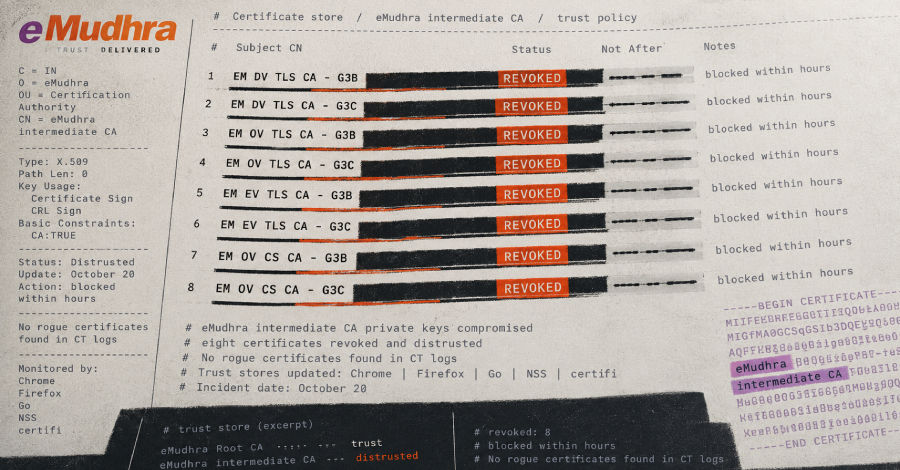
What Happened
On October 20, 2026, researchers discovered that the private keys for eight intermediate certificate authority (CA) certificates owned by eMudhra — a trusted root CA — have been compromised. This means that anyone who obtained these keys can now generate valid SSL/TLS certificates that any modern browser would accept as legitimate. Such certificates are used to encrypt data between users and websites, and they form the foundation of HTTPS security.
The compromise affects any website that relies on eMudhra's intermediate CA to sign its certificates. Because intermediate CAs act as intermediaries in the chain of trust, their keys grant broad authority over all downstream certificates issued under them. With eight such keys exposed, attackers theoretically have the ability to issue fraudulent certificates for virtually any domain, enabling sophisticated phishing attacks, man-in-the-middle hijacking, and other forms of site takeover.
The Key Details
Scope of the Breach
- Number of compromised keys: Eight intermediate CA certificates
- Owner: eMudhra (a trusted root CA)
- Confirmed by: Mozilla and Google's Chrome Root Program
- Date of confirmation: October 20, 2026
How It Works
Intermediate CAs serve as middlemen in the public key infrastructure (PKI). When a website needs a certificate, it requests one from its chosen intermediate CA. That CA then signs the final certificate and distributes it to the website. Modern browsers maintain a list of trusted roots and intermediate CAs. If an attacker obtains an intermediate CA's private key, they can sign any certificate that the browser accepts, effectively impersonating any domain.
This is why the compromise of just eight keys is particularly severe — each key can be used to issue millions of potentially malicious certificates without detection by end-users or browser security checks.
Current Status
Major technology companies have already begun rolling out emergency patches. Both Mozilla (Firefox) and Google (Chrome) have released updates to their respective browser engines, which will invalidate certificates signed with the compromised keys. These updates are part of broader efforts to harden the trust chain against supply-chain style attacks targeting certificate authorities.
Why It Matters
Digital trust is built on the assumption that the entities we trust — browsers, operating systems, and certificate authorities — are honest and secure. This incident reveals a significant gap in how organizations manage the lifecycle of their root and intermediate CAs. Even when a company has implemented strong internal controls, external breaches of third-party cryptographic materials can undermine years of security investment.
For everyday internet users, the practical impact may seem abstract until a real-world exploit occurs. However, the ripple effects include:
- Increased risk of phishing — Attackers could create fake login pages that appear legitimate because they use valid-looking certificates.
- Potential for business disruption — Organizations that rely on eMudhra's infrastructure could face service interruptions if their own certificates are affected.
- Broader ecosystem concern — Other CAs may face similar threats, making this a systemic issue rather than isolated to eMudhra.
What It Means for Readers
- If you use Chrome or Firefox: The upcoming browser updates will help protect you. Ensure your browser is up to date after receiving the latest security patch.
- For developers and system administrators: Review your own PKI configurations. Verify that your organization's root and intermediate CAs are properly secured and that backup copies of private keys exist offline.
- For students and tech enthusiasts: This incident underscores the importance of cryptography hygiene. Keeping software updated and understanding how certificate chains work are essential skills in today's threat landscape.
- General advice: Treat any unfamiliar certificate warning in your browser as a potential red flag. Browser security teams continuously monitor for such issues, and staying current with updates remains the best defense.
What Happens Next
Mozilla and Google have committed to ongoing monitoring and patching. Additional vendor responses (such as Safari, Edge, and other browsers) are expected to follow. The full scope of the damage — including whether any previously issued certificates were compromised — will require further investigation and may extend beyond the initial eight keys. Users should expect continued communication from these organizations throughout November and December 2026 as the situation evolves.
Takeaway
The compromise of eight eMudhra intermediate CA keys represents a serious breach of digital trust infrastructure. While immediate browser updates mitigate the acute risk, the incident highlights the fragility of certificate authorities and the critical need for robust key management practices across the entire technology stack.


