What Happened
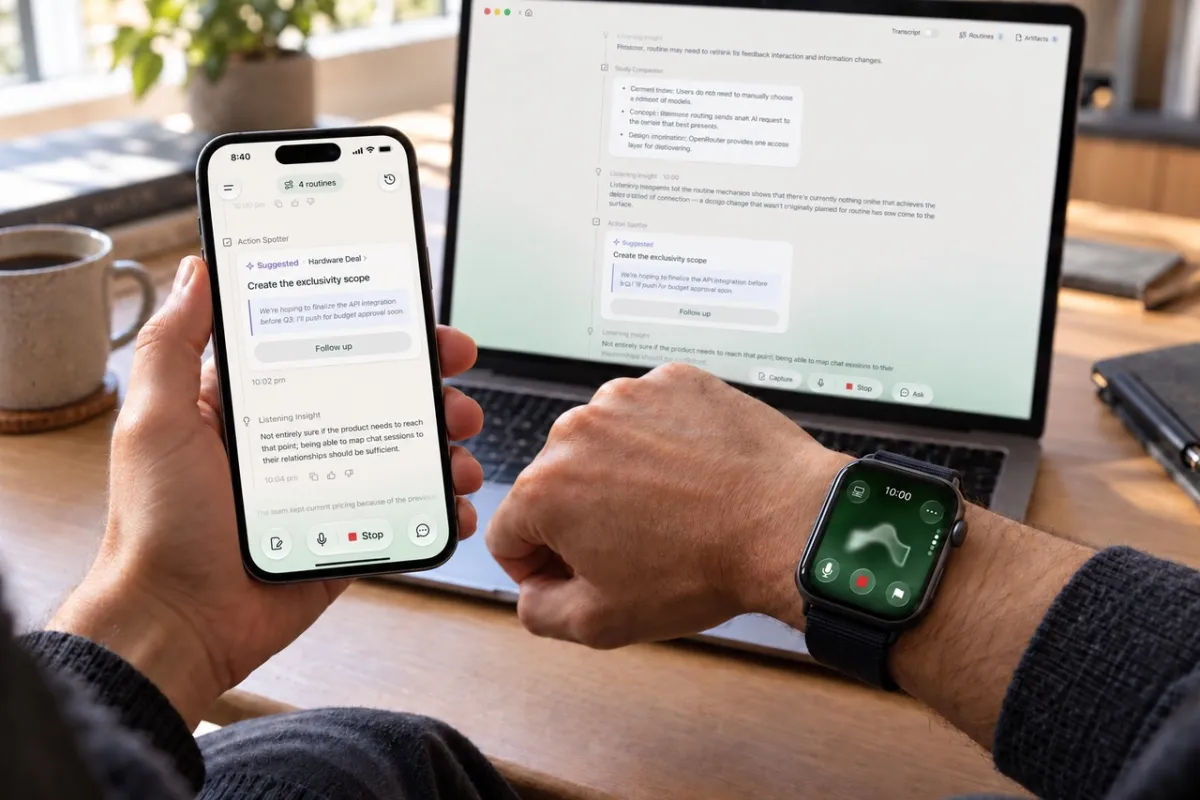
Former Plaud executive Peter Mo has secured $26 million in funding for Ambi, an AI-driven app that listens to users continuously to deliver real-time intelligence and insights. The startup, now called Ambi, positions itself as a next-generation meeting assistant that goes beyond traditional note-taking by actively suggesting actions during conversations.
The company launched multiple funding rounds led by Luminous Ventures—a venture firm that has previously backed Meituan and Unitree Robotics—and partnered with Huaqin, an original design manufacturer (ODM). This capital infusion reflects investor interest in AI agents that operate "anytime and anywhere," rather than waiting for manual recording transfers.
The Key Details
Company & Leadership
- Founder/CEO: Peter Mo, formerly an executive at Plaud
- Headquarters: San Francisco, Beijing, Shanghai, and Shenzhen (over 50 employees)
- Funding: $26 million across multiple rounds, led by Luminous Ventures
- Partners: Huaqin (design/manufacturing partner)
Product Overview
- Name: Ambi
- Core Function: Real-time intelligence and insights through continuous audio monitoring
- Platform Availability: iPhones, Macs, and Apple Watch
- Key Feature: Meeting notetaking that starts proactively during conversations—using calendar data, meeting schedules, personal knowledge bases, and web information to surface relevant context and suggestions mid-meeting
- Cross-Device Continuity: Tasks initiated on one device (e.g., iPhone) can be continued on another (e.g., Mac or Apple Watch)
Hardware Roadmap
- Desktop App: Coming soon, designed to analyze user work patterns and store important information for personalized suggestions
- Own Hardware Device: Under planning—a screen-equipped device with speaker, camera, and microphones to capture context and display information
Privacy & Transparency
- Data Capture: Ambient listening is optional and can be turned off at any time (feature is off by default)
- Storage Claims: Startup states it does not store user recordings and encrypts data (specific encryption method not disclosed)
- Industry Challenge: Mo acknowledges that the broader industry lacks adequate disclosure mechanisms for ambient capture—users often cannot easily signal to others that their conversations are being recorded. Some meeting notetakers have faced lawsuits for unauthorized recording. Apple’s recent Audio Intelligence feature, which transcribes speech continuously, has amplified these concerns.
Why It Matters
Ambi represents a significant shift in how AI assistants engage with users. Traditional meeting tools require users to manually start notes, review transcripts afterward, and then act on extracted insights. Ambi aims to close that gap by providing proactive, contextual assistance directly during the meeting—based on the user’s schedule, prior commitments, and digital footprint.
This approach aligns with a broader trend in AI personalization: the more context an assistant has about a person’s life, the more relevant and helpful its recommendations become. However, it also intensifies existing privacy debates. By continuously listening without explicit, always-visible consent signals, Ambi operates in a gray area that has already triggered legal challenges in other sectors.
For businesses and developers, the rise of ambient AI assistants opens new possibilities for productivity tools—but it also demands stronger platform-level safeguards. As Mo puts it, the burden of disclosure falls largely on individual users, leaving room for industry-wide solutions to address the transparency gap.
What It Means for Readers
- For Technology Enthusiasts & Developers: Ambi demonstrates the growing viability of AI agents that integrate deeply into daily workflow—not just as reactive responders but as proactive collaborators embedded in meetings and calendars.
- For Business Professionals: The ability to receive real-time, context-aware suggestions during critical meetings could enhance decision-making, but organizations should weigh the privacy implications and ensure compliance with applicable data protection regulations.
- For Everyday Users: The app offers convenience—automatic note-taking and smart suggestions—but users should remain aware that ambient listening occurs by default and that disclosure to others is ultimately their responsibility.
- For Investors: The $26M round suggests strong market appetite for AI agents that blur the line between passive notification and active assistance. Success will depend on balancing utility with trust-building measures around privacy and transparency.
What Happens Next
Ambi is actively expanding its ecosystem:
- Desktop Integration: A desktop version will enable cross-device analysis and persistent memory storage for more personalized experiences.
- Hardware Launch: The company plans to introduce its own hardware device equipped with a screen, speakers, camera, and microphones to deliver a unified, ambient-capable interface.
- Team Growth: With over 50 employees across four major offices, Ambi is hiring for go-to-market functions and AI engineering roles focused on speech recognition models.
VANTIX Takeaway
Ambi is pioneering a new generation of AI assistants that listen continuously to provide real-time, context-aware guidance—ushering in an era where intelligence moves seamlessly from the moment of interaction into the spaces between tasks. However, realizing this vision responsibly requires addressing the privacy paradox inherent in ambient AI: the more insight an assistant gains, the greater the obligation to be transparent about how that data is used.


