What Happened
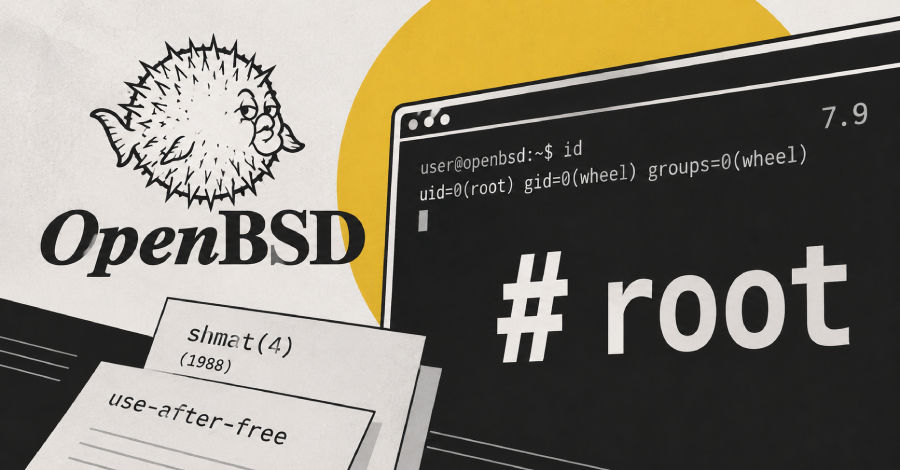
Security research firm Calif has published a local privilege escalation exploit that achieves root access on OpenBSD 7.9. The exploit chains two vulnerabilities: an integer overflow believed to be roughly 37 years old, located in shared-memory code, and a separate, unnamed kernel flaw. Together, they allow an attacker with local access to bypass OpenBSD's KARL kernel-address randomization as well as the SMAP and SMEP hardware protections designed to prevent kernel exploitation.
The Key Details
- Target: OpenBSD 7.9
- Attack type: Local privilege escalation to root
- Vulnerabilities chained: A roughly 37-year-old integer overflow in shared-memory code, plus a separate kernel flaw not identified in the available report
- Protections bypassed: KARL (kernel-address randomization), SMAP (Supervisor Mode Access Prevention), and SMEP (Supervisor Mode Execution Prevention)
- Researcher: Security firm Calif
- Public status: Calif published a detailed writeup and full proof-of-concept code
The available source material does not specify whether OpenBSD has released patches, whether earlier versions are affected, or the technical details of the second kernel flaw.
Why It Matters
OpenBSD is widely regarded as a security-focused operating system. Mitigations such as KARL, SMAP, and SMEP are intended to make kernel attacks significantly harder by randomizing memory layout and restricting how the kernel can access or execute user-space memory.
The fact that a decades-old integer overflow can still be chained with another flaw to defeat these protections shows that legacy code can remain a serious risk even in systems built with modern security in mind. Because the exploit requires local access, an attacker must already be able to run code on the target machine, but successful exploitation would grant full administrative control.
What It Means for Readers
This development is most relevant to:
- System administrators running OpenBSD servers or workstations, who should monitor official OpenBSD security advisories for patches or guidance
- Security researchers studying exploit chaining and kernel mitigation bypasses
- Developers maintaining older code, as it illustrates how old bugs can survive for decades and combine with newer flaws
For general technology users who do not run OpenBSD, the immediate practical impact is limited. OpenBSD is not a mainstream desktop or mobile operating system, and the exploit is not remote.
What Happens Next
Calif has published its writeup and proof-of-concept code. Readers should watch the OpenBSD project's security advisories and mailing lists for patches or official statements. Whether OpenBSD 7.9 users can apply fixes immediately depends on information not included in the available source material.
VANTIX Takeaway
A 37-year-old bug in shared-memory code can still be weaponized today when combined with another kernel flaw, even on an operating system designed around strong exploit mitigations. The key lesson is that old code does not become safe simply because it has survived for decades, and local privilege escalation remains a viable path to full system compromise.


