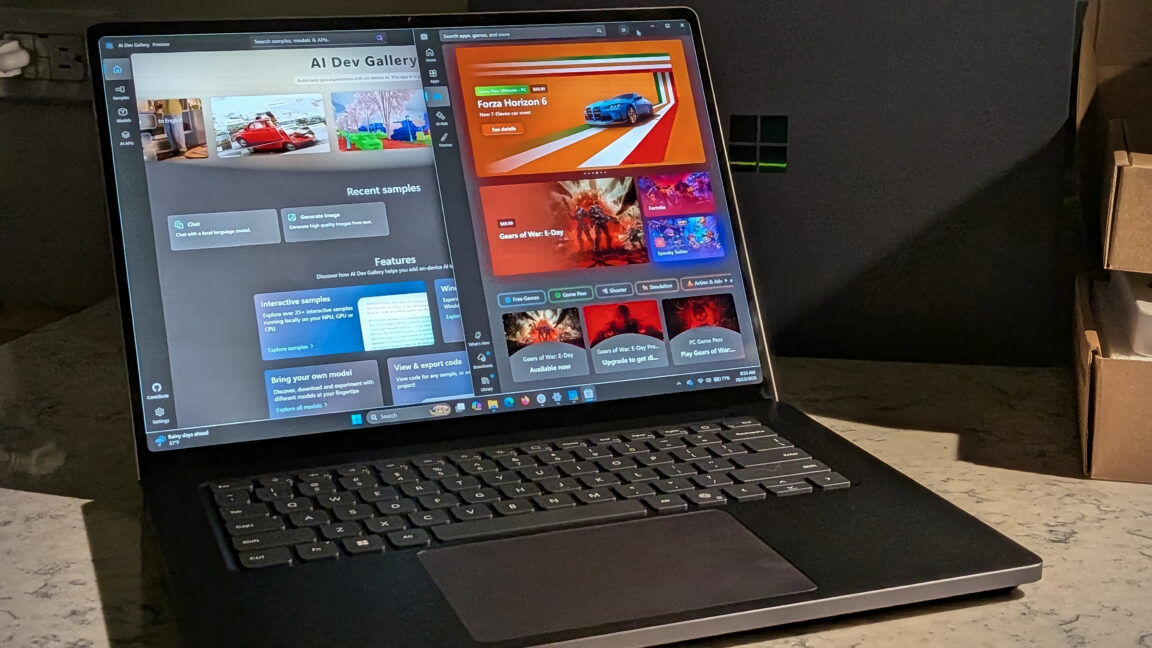
# What Happened Microsoft released the Surface Laptop Ultra, a premium 15‑inch laptop built around Nvidia’s RTX Spark platform (Grace CPU + Blackwell GPU). The device was reviewed by Ars Technica, which found it capable of running AAA games, large AI models, and demanding workloads while noting that several promised software features are still unavailable.
The Key Details
- Processor and GPU: Nvidia RTX Spark combines a Grace CPU with a Blackwell GPU; there is no dedicated NPU, so AI work relies on unified memory and the GPU.
- Memory and Storage: Unified memory options start at 24GB (ships with Windows 11 Home) and go up to 64GB (tested unit) with Windows 11 Pro.
- Display: 15‑inch mini‑LED panel, 3270×2180 resolution, 2,000‑nit peak brightness, excellent colour reproduction and viewing angles.
- Keyboard and Trackpad: Premium typing experience similar to a 2020 MacBook Pro; large haptic trackpad (5.5×3.5 inches).
- Charging: First built‑in magnetic USB‑C charging on a laptop; the cable breaks away safely if yanked.
- Pricing: Base model $2,599; fully specced configurations reach $5,899.
- Gaming Performance: AAA titles such as Gears of War: E‑Day and Forza Horizon 6 run well; the system reported up to 46.7 GiB of the 64 GiB unified memory available as VRAM during gameplay.
- AI Performance: Using Ollama, a Llama 3.3‑70 b model ran at ~6.26 tokens/sec via GPU acceleration. AI Dev Gallery offered limited GPU paths for image generation but conversational models remained CPU‑only; Phi Silica requires developer registration.
- Software Status: The laptop will be certified as a Copilot+ device, but full Copilot+ features (Recall, Click to Do, new Windows search) are expected only in late 2026 or early 2027. Many apps run natively on ARM; others rely on the Prism emulator, with potential issues for kernel‑level anti‑cheat or specialized drivers.
- Battery and Audio: Mixed‑use testing showed ~66 % battery remaining after three hours; speakers are loud enough for a basement test, though low‑end frequencies are limited.
Why It Matters
The Surface Laptop Ultra demonstrates that ARM‑based hardware can now deliver performance levels traditionally associated with high‑end x86 gaming laptops and workstations, thanks to the tight CPU‑GPU integration and unified memory architecture. For developers and power users who need portable CUDA compute or want to experiment with large language models locally, the device offers a tangible option today. However, the gap between hardware capability and ready‑to‑use software means that the promised all‑in‑one experience is not yet fully realized.
What It Means for Readers
- Developers and AI experimenters: If you have a budget of $2,600‑$5,900 and need a portable machine that can run large models via GPU acceleration, the Surface Laptop Ultra is currently one of the few laptops that can do this on ARM.
- Gamers: The laptop can run current AAA titles with ray tracing and DLSS at playable frame rates, making it a viable alternative to a traditional gaming notebook—provided you accept the ARM‑specific emulator caveats.
- Everyday professionals: For typical office work, web browsing, and media consumption, the device offers a premium build and excellent display, but the high price may be hard to justify unless you also need its gaming or AI capabilities.
- Cautious buyers: Because Copilot+ features and complete AI software support are still months away, users who rely on those specific Windows AI tools may want to wait for later revisions or clearer roadmap timelines.
What Happens Next
Microsoft has indicated that full Copilot+ support will arrive in late 2026 or early 2027, and driver/software maturity for the RTX Spark platform is expected to improve over the same period. As more ISVs optimize applications for ARM64 and as AI tooling catches up to the hardware, the value proposition of the Surface Laptop Ultra should increase.
VANTIX Takeaway
After reading this, the most important takeaway is that the Surface Laptop Ultra delivers impressive hardware performance for gaming, AI development, and productivity on an ARM platform, but the complete software experience—particularly Microsoft’s Copilot+ suite and seamless AI tooling—is still forthcoming, so prospective buyers should weigh current capabilities against pending features and price.


